Invitation and greeting card projects fail in the same three places: the card stock is too thin, the envelope does not match, and the finish that looked elegant on screen looks messy in the hand. None of those are expensive to get right — they are expensive to fix after printing.
We produce invitation and greeting card sets at a 500-piece minimum. This is the checklist we walk buyers through before a job is quoted.
The set, not the card
A greeting card is a system: the card, the envelope, sometimes a vellum band, a wax seal, a ribbon, a dried flower. Each piece has its own paper weight and finish, and they have to sit together in one photograph.
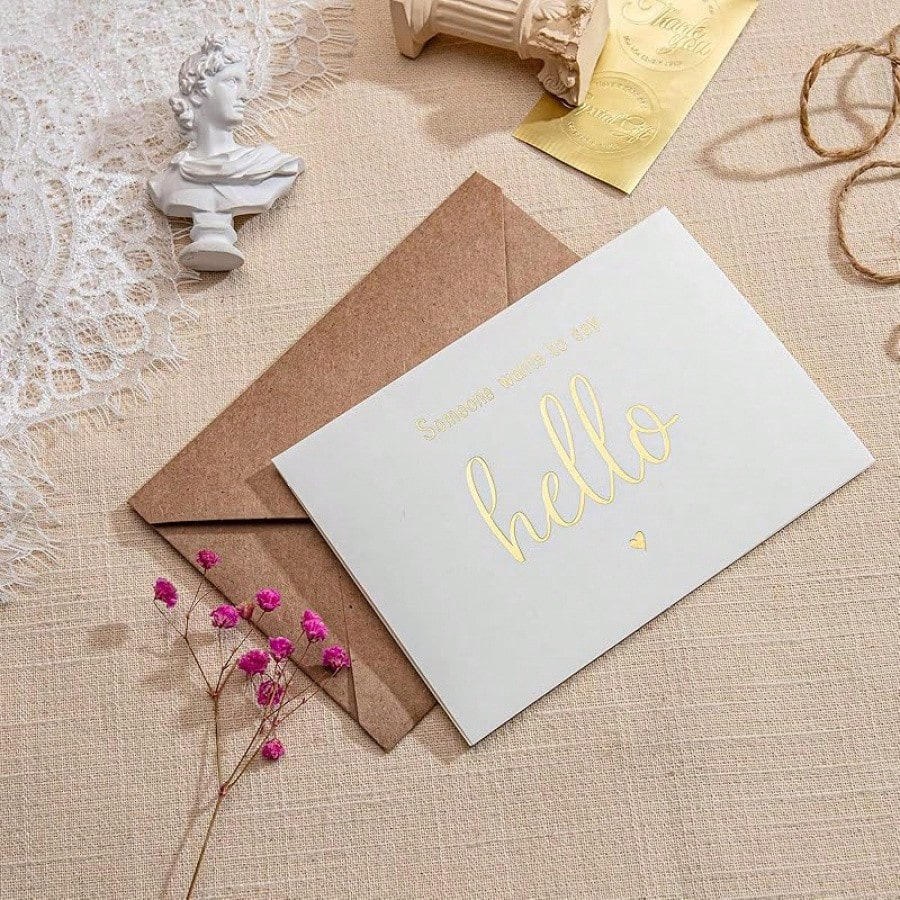
Our hello greeting card set is a 300 gsm art card with a 120 gsm kraft envelope, A6 and A5, with a hot-foiled “hello” in a handwritten script and a blind-debossed border. Two finishes, one card, and the kraft envelope does the colour work.
The green wedding invitation card runs 300 gsm art card with a 150 gsm art envelope, deep green and sage tones, foil type, a wax seal and a hand-placed dried flower. That is a five-component set; it needs a sample, not a guess.
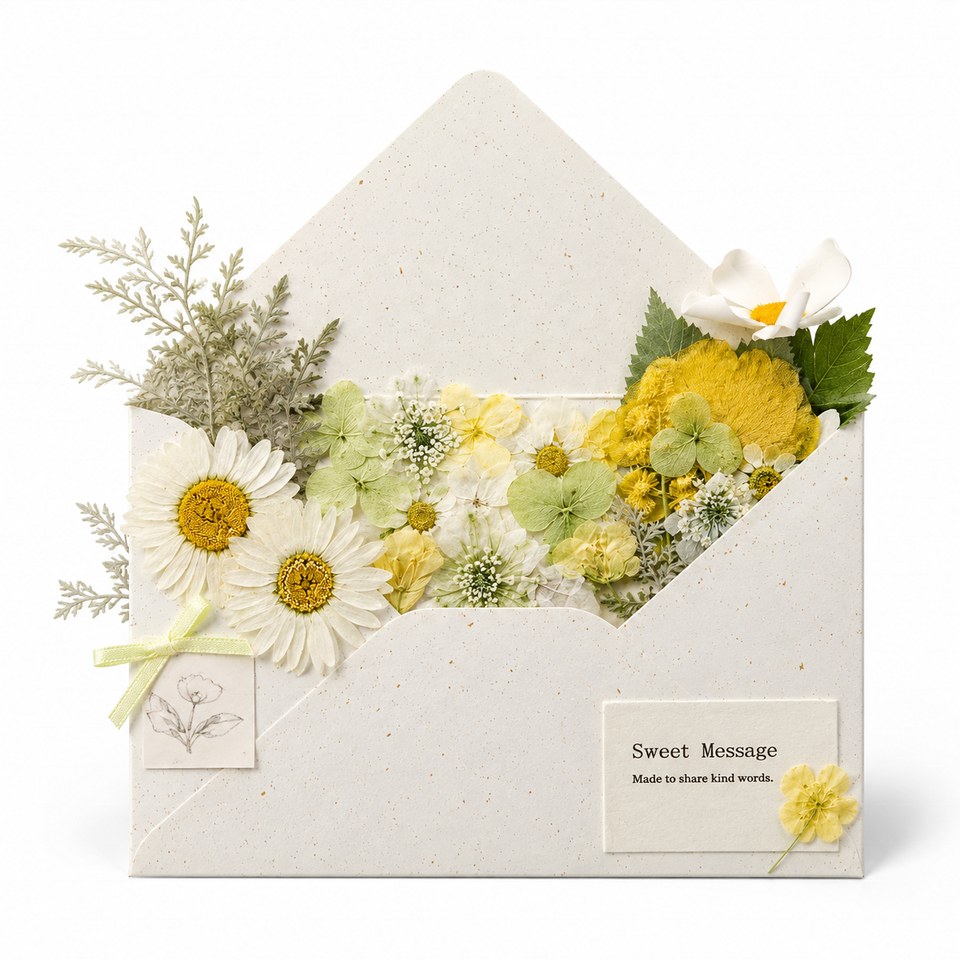
Our dried flower envelope card is an envelope-shaped card with a real dried flower behind a 120 gsm vellum band. The vellum is what makes it work — it hides the flower’s edges and softens the print.
Paper weights that survive the post
300 gsm art card is the standard for a card that is handled, mailed and stood on a shelf. 350 gsm is stiffer and reads more expensive; above that it starts to crack at the fold unless it is scored properly.
Below 250 gsm, a card feels like a flyer. It will bend in the envelope, and the recipient notices before they read the message.
For envelopes, 120 gsm kraft or 150 gsm art pairs correctly with a 300 gsm card. Vellum is decorative and fragile; use it as a band or an outer layer, not as the only envelope.
Finishes: pick two, not five
Hot foil stamping is the strongest single upgrade. One foil block on the card face or the envelope flap changes the perceived price of the whole set.
Blind deboss adds texture with no colour. On uncoated stock it is subtle; on coated stock it barely registers. It is a touch finish.
Letterpress-style deep impression is slower and needs a heavy cotton stock. It is a genuine craft signal and a genuine cost.
Wax seals are hand-applied. They look beautiful, they crack in transit, and they add a manual step. Plan for a small percentage of breakage.
Dried flowers are hand-placed and never identical. That is the point; it is also why they cannot be promised as “exactly like the photo”.
Ribbon and vellum bands hold the set together and give the photographer a second surface. They also slow packing, which is why they belong in the quote from the start.
| Component | Typical spec | Failure if skipped |
|---|---|---|
| Card | 300 gsm art card, scored | Cracks at the fold, bends in transit |
| Envelope | 120 gsm kraft or 150 gsm art | Set feels mismatched, card edges show |
| Band | 120 gsm vellum or printed paper | Loose pieces, no shelf presence |
| Seal | Wax, hand-applied | No ceremony, but also no breakage |
MOQ, lead time, and the sample
Minimum is 500 sets. Sample runs 5–7 working days; mass production 5–7 working days after approval; FOB Xiamen.
For a wedding or a single event, 500 is more than you need. The honest options are a stock card with a printed or foiled monogram, or a short digital run outside the standard minimum. What we will not do is quote a 100-piece custom set and then deliver a different paper.
Buyer’s checklist
1. Final card size, and whether it is a flat card or a folded card.
2. Card weight — 300 gsm minimum for anything mailed.
3. Envelope size and paper, matched to the card weight.
4. Number of finishes, and which surface each one sits on.
5. Whether any component is hand-applied (seal, ribbon, flower) and how many.
6. Packing method — flat, boxed, or in a vellum band.
7. Artwork with bleed and safe margins, and a foil colour chip if foil is used.
8. Quantity and delivery date, counting transit.
FAQ
Can the card be printed on both sides? Yes. A flat card with a message on the back is standard; a folded card gives you four printable panels.
Does foil work on kraft? Yes, but the foil sits on a rougher surface and reads slightly matte. On coated art card it reads sharper.
Can you match a previous set exactly? If you send a physical sample, yes. If you send a photo, we can match the structure and approximate the colour, and we will say so.
The full range is on the greeting cards and sleeves page. Send the checklist above and we will quote against it rather than against an assumption.
Under the minimum? Tell us the quantity you actually need — small runs get quoted case by case.