An envelope is the cheapest part of a mail piece and the part that decides whether it gets opened. Buyers usually come to us with one of two problems: the envelope looks nothing like the card inside, or the quote came back three times the expected price because the spec asked for four finishes.
We run custom envelopes at a 500-piece minimum in Xiamen. Here is what matters when you specify one.
The five envelope types worth knowing
V-flap (banker’s flap). The flap is a deep V with a gummed or peel-and-seal edge. It is the formal default for invitations, corporate mail and greeting cards. Our vintage airmail envelope is a V-flap with a printed airmail border.
Wallet / pocket envelope. A single-fold pocket, usually open on the long edge. Used for catalogues, folders and presentation sets.
String-and-button. A reinforced flap closed with a cotton string around a button. Reusable, and it reads as official — good for legal, archival and corporate documents.
Bubble-lined. Kraft or white outer with a bubble film inside. For samples, jewellery and anything that must survive a postal sorting machine.
Open-end / catalogue. Open on the short edge, no flap. Used for brochures and mailers that are inserted mechanically.
Paper selection
120 gsm kraft is the workhorse for uncoated, natural-looking mail. It prints soft and feels honest. Good for thank-you cards, small brands, wedding stationery with a rustic direction.
150 gsm art paper is the standard for printed envelopes that need colour accuracy. Smooth, bright white, holds fine type. Our wedding invitation suite uses a 150 gsm art envelope to match the 300 gsm card.
Vellum / translucent paper is the decorative option — printed or unprinted, wrapped as a band or used as the outer envelope so the card shows through. It is beautiful and it tears. Ship it flat, not in a stack under weight.
One rule: the envelope should weigh less than the card stock but not by much. A 300 gsm card in a 80 gsm envelope feels like a mismatch in the hand before it is even opened.
Printing and finishing
Offset printing gives you full colour and consistent results at 500+. It is the default.
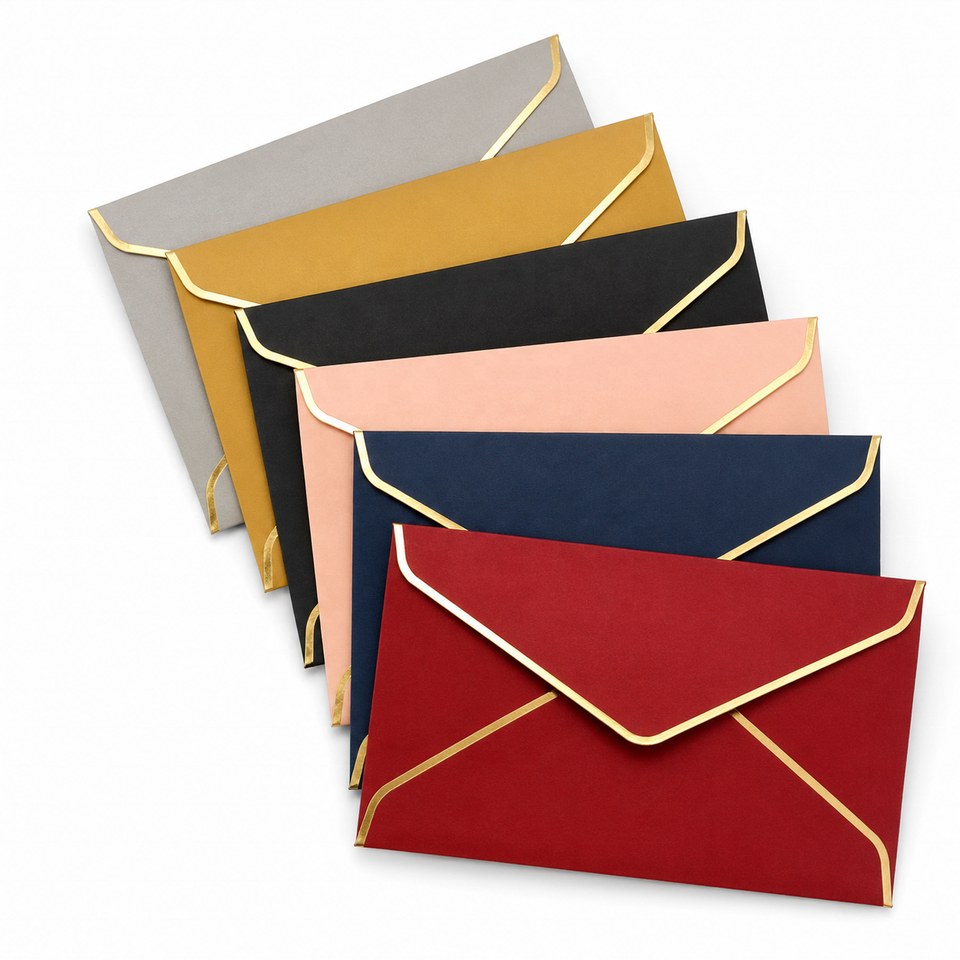
Hot foil stamping on the flap or the return address area is the fastest way to make an envelope look expensive. One small foil block costs far less than a full-colour print and reads stronger. Our gold foil metallic edge envelope uses foil plus a printed metallic border.
Embossing or debossing adds a tactile mark without colour. Blind emboss on uncoated stock is subtle and photographs badly — it is a touch product, not a screen product.
Inside liners — a printed tissue or coloured paper liner inside the envelope — are a low-cost upgrade that most recipients never expect. They also hide the print show-through on thin stock.
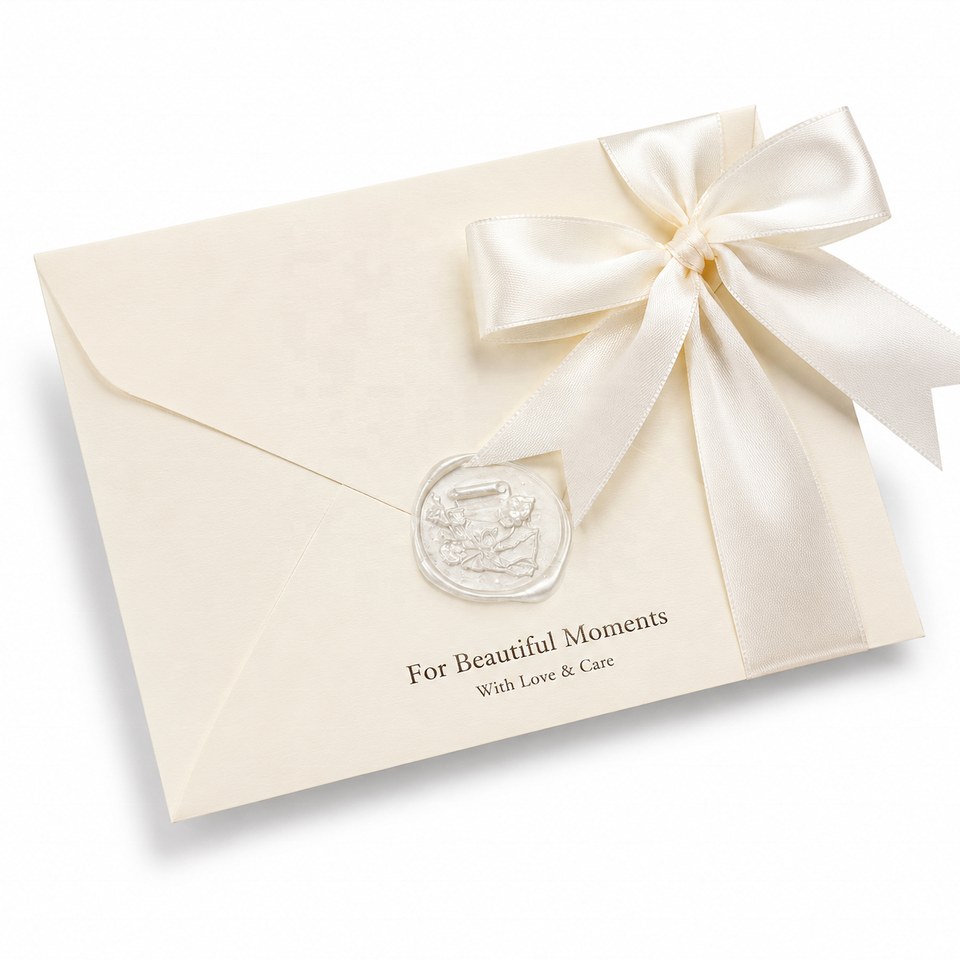
Wax seals and ribbons are hand-applied. They add labour, they add charm, and they add a step that has to be scheduled. Our white satin bow envelope pairs a ribbon with a wax seal.
Standard sizes, and when to go custom
For greeting cards, A6 (114 × 162 mm) and A5 (148 × 210 mm) card sizes map to C6 and C5 envelopes. For business mail, DL (110 × 220 mm) fits a tri-folded A4. For invitations, the square 130 × 130 mm and 150 × 150 mm formats are common because they photograph well.
Custom sizes are normal, not exotic. The cost difference is a die, not a different process. Go custom when the card is non-standard or when the envelope has to fit a box or a mailer.
| Use case | Paper | Finish |
|---|---|---|
| Wedding invitation | 150 gsm art | Foil + wax seal + ribbon |
| Thank-you card set | 120 gsm kraft | One-colour print |
| Corporate mail | 120 gsm art / kraft | Logo foil, no liner |
| Sample / jewellery mailer | Kraft + bubble | Plain or one-colour |
Why 500 is the floor
Envelope production is folding and gluing on a machine. The make-ready — setting the fold plates, the glue heads, the flap gumming — takes longer than running the first few hundred pieces. At 500 pieces that setup is amortised to a sensible number; at 50 it is not.
If you need a small quantity for a real event, the honest route is a stock envelope with a printed label or a digital print short run, not a full custom build.
Three spec mistakes
Printing full bleed on a kraft envelope. Kraft absorbs ink unevenly; a full-bleed dark panel will show mottling. Either accept a textured look or switch to coated stock.
Foil on a thin flap. Foil needs heat and pressure. On a 80–90 gsm flap the block can distort the paper edge. Use 120 gsm or above for a foiled flap.
Forgetting the insert weight. A wax seal plus a ribbon plus a 300 gsm card can push a standard envelope over the postal weight limit for a single stamp. Check the finished weight before you design the mailer.
FAQ
Can you print inside the envelope? Yes, on a liner or directly on the inner surface, but direct inside printing limits the paper and slows the fold. A liner is usually the better answer.
Do you make envelopes to match a card you printed elsewhere? Yes. Send the card; we will match the paper tone and size.
Lead time? Sample 5–7 working days, mass 15–20 working days after approval, FOB Xiamen.
Our envelope range is on the custom envelopes page. For a quote, send the card size, the paper you want, the finish, and the quantity.
Under the minimum? Tell us the quantity you actually need — small runs get quoted case by case.